
What is a boundary, and how do you hold it?

By Olena Baeva
Published 15 November 2026
In June 2015, Donald Trump launched his presidential campaign with a promise to build a wall along the US–Mexico border and make Mexico pay for it. Mexican leaders publicly refused. The barriers built during Trump’s first term were funded by the US federal government. rollcall.com
When I use this story to explain boundaries, the part I’m interested in is who pays for the wall. Announcing how you intend to protect yourself doesn’t give you the power to make someone else carry it out or bear the cost. You can ask for cooperation. What will you do if the answer is no?
A boundary is a limit on your participation
Alex and Sam are arguing about whose turn it was to book the plumber. Somewhere between the plumber and the last three things Alex forgot, Sam calls Alex an idiot.
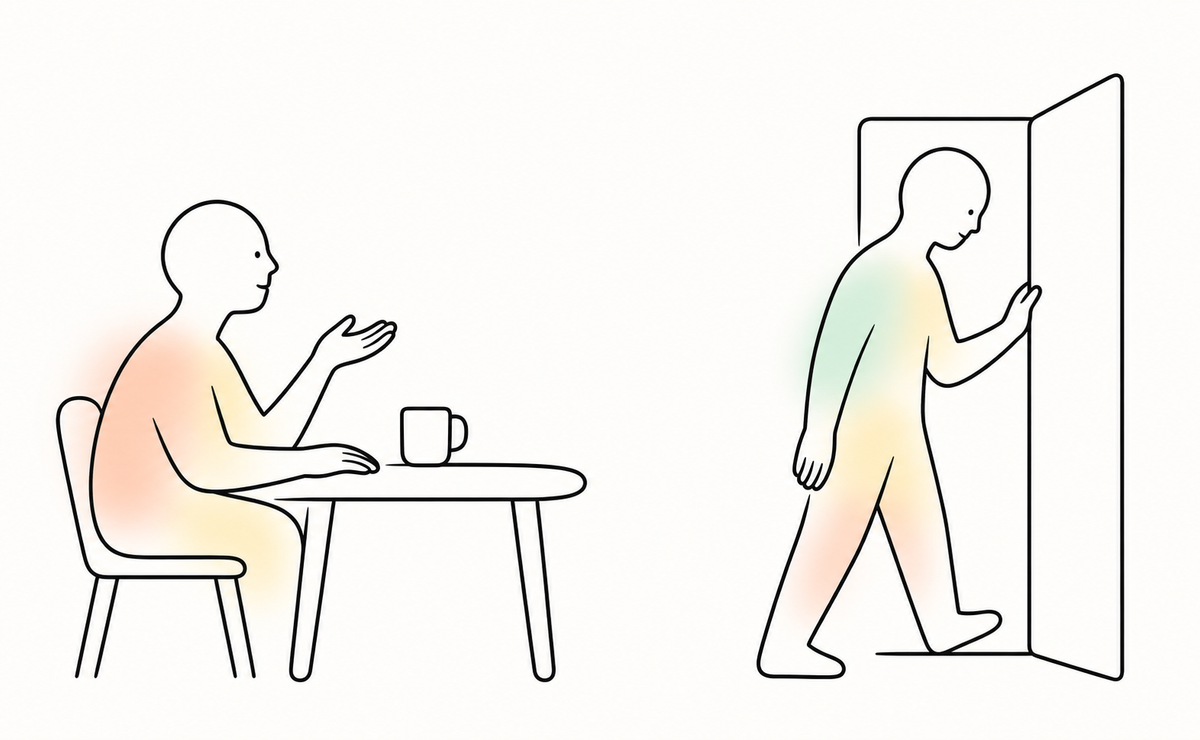
“Please don’t call me that,” Alex says. That’s a request. If Sam stops, they may be able to get back to the plumber. If Sam carries on, Alex can say, “I’m ending this conversation for now,” and leave the room. Sam can still speak. Alex has withdrawn from the conversation.
The boundary is I’m unwilling to stay in a conversation where I’m being insulted. Leaving is how Alex acts on it. Alex can tell Sam in advance what they intend to do, and they can agree together on how to pause and come back. Alex can also leave without first getting Sam’s agreement that the word was insulting or that leaving is justified. This distinction between what you ask of another person and what you can do yourself appears in several approaches to relational boundaries. www.thetbs.org
The same distinction applies when you want someone to start doing something. Robin says to Jules, “I’d like to know more about what matters to you. Would you be willing to tell me?” It’s a request, and Jules can decline. Robin might also realise, I need some mutual openness to stay in a close relationship. That’s a condition of Robin’s continued participation. If the relationship consistently offers less closeness than Robin needs, Robin can decide whether to stay. Jules’s preference for privacy can be legitimate even if it makes the relationship unworkable for Robin.
Saying you might leave can put real pressure on someone. What happens after a refusal tells you more than the wording. Does Robin take Jules’s answer seriously and consider what it means for the relationship? Or does each refusal prompt Robin to threaten to leave again? Rosenberg makes a similar point about requests. How we respond to a no reveals whether we were prepared to hear one. commons.princeton.edu
What a Schelling fence adds
Knowing your limit and being able to act on it are two different things. Alex knows they’re unwilling to be insulted. Yet the first time Sam says “idiot”, Alex thinks, It was one word. Let’s just finish the conversation. The next time, Alex stays to explain why it hurt. Twenty minutes later, they’re still arguing about whether Alex is too sensitive to take a joke. Leaving now feels harder. Alex wants to clear up one more misunderstanding before going.
In his essay on Schelling fences, Scott Alexander uses the example of playing Civilization late at night. At midnight, one more turn seems worth ten minutes of sleep. At ten past midnight, the same deal seems just as reasonable. Each decision is easy to justify on its own. Together, they can keep him up all night. Midnight gives him a clear stopping point he can commit to while he still has some distance from the decision. readscottalexander.com
Alex can use the same idea. “At the first insult, I’ll end the conversation and decide later whether to return to it.” The first insult is the cue. Leaving is the action. The point of choosing the first insult is that Alex knows what usually happens after they let it pass. A Schelling fence is a recognisable point you decide in advance to act on because each small exception can make the next one easier. That’s a practical application of Alexander’s idea to relationships. www.lesswrong.com
Sometimes it makes sense to repeat a request. You may have been misunderstood, or you may want acknowledgement and repair. When the pattern is already clear, saying it again may communicate how much it hurts while doing little to interrupt it. The next question is What can I actually do here? That depends on the situation. Leaving the room, ending a call and leaving a relationship carry very different costs. Someone can know exactly where their boundary is and have very little room to act on it.
When it makes sense to redraw the fence
Suppose Sam tells Alex they have Tourette’s and explains that the particular word Alex heard was an involuntary vocal tic. Some vocal tics can include offensive words or phrases. That changes what the cue tells Alex about what happened. Alex can keep the boundary around insults used in an argument while recognising that a tic is a different event. If the sound or words are still overwhelming, Alex can step out to recover without treating Sam as though they’d chosen to insult them. www.ninds.nih.gov
Or suppose Jules wants to share more with Robin but rarely has words for what they’re feeling when asked on the spot. Later, they can write about what an experience meant to them. Robin might find that this gives them the sense of knowing Jules they were looking for. They might also find that it still leaves them lonely. Understanding what Jules can offer helps Robin make a decision about the relationship they actually have.
Before drawing a fence, ask what am I protecting, what will tell me it’s time to act, and what can I realistically do then? If new information changes what the cue means or reveals another way to meet the need, you can redraw the line. If the same exception keeps carrying you further into a situation you already know you want to leave, a clear stopping point can help you act while you still have the capacity to choose.