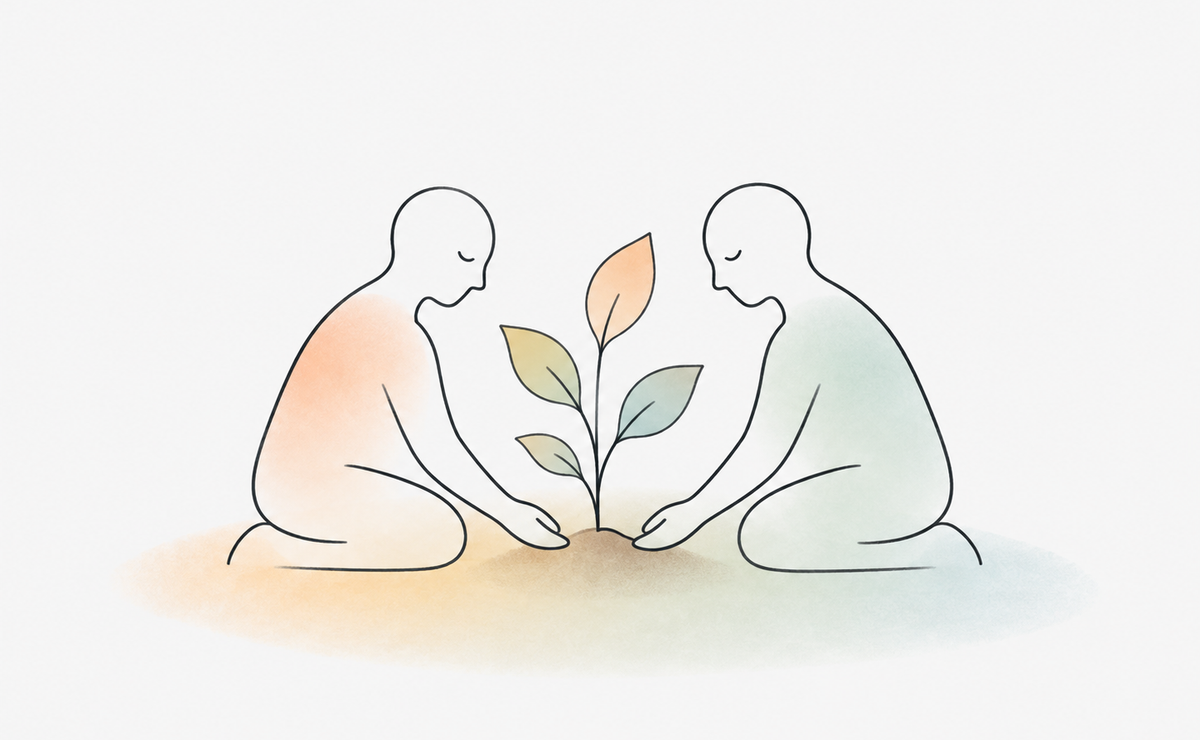
Why insecure people may find each other and how secure relationships can still develop
By Olena Baeva
Published 21 September 2026
People do not usually choose insecurity.
They choose what feels recognisable, believable and possible.
That distinction matters, because the popular story “you keep choosing unavailable people because that is what you are used to” is too simple. It turns a complex relational process into a character judgement.
Research suggests something more interesting.
Relationships emerge through several filters at once: who we notice, whose behaviour we can read, whose interest we believe, who responds to us, who stays, and which early relationships gain enough momentum to become established.
Insecurity can shape every one of those filters.
We do not choose partners in a vacuum
Couples are not randomly matched.
Research on assortative mating shows that people tend to pair with others who resemble them in age, education, beliefs, social background and some psychological characteristics.
There is also evidence that partners can be similar in levels of anxiety, depression, self-esteem, attachment insecurity and exposure to difficult childhood experiences.
That does not prove that insecure people are consciously or unconsciously attracted to insecurity itself.
It tells us something narrower:
vulnerability tends to cluster within couples.
The mechanism is likely to be relational selection rather than a hidden wish for pain.
Wanting someone is not the same as ending up with them
Most explanations of partner choice focus on attraction.
But relationships require mutual selection.
You can want ten people. A relationship only develops with someone who wants you back, responds to your signals, tolerates your way of relating and remains long enough for something to form.
That changes the question.
Instead of:
“Why do I always choose insecure people?”
it may be more accurate to ask:
“Why do relationships with certain people repeatedly become mutual?”
Secure people may sometimes step away from intense reassurance-seeking, volatility, withdrawal or chronic mistrust.
Another insecure person may be more likely to stay, pursue, tolerate ambiguity or become strongly invested very quickly.
The final pairing can therefore look like preference when it may partly be reciprocal filtering.
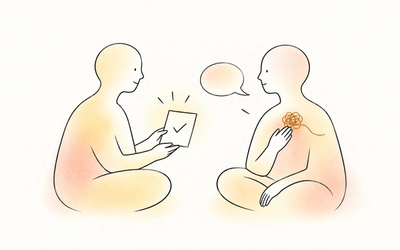
Familiarity can feel like recognition
Earlier relationships teach us what closeness looks like.
If someone has repeatedly known people who withdraw when upset, become unpredictable, need reassurance, hide their needs or fear rejection, they become skilled at reading those patterns.
They may not like them.
They may simply understand them.
That can create a powerful feeling of:
“You get me.”
Sometimes they really do.
Two people with similar relational histories may recognise each other's pauses, distancing, intensity and attempts to reconnect with very little explanation.
There is less translation.
But familiarity is not the same as safety.
A relationship can feel immediately legible because it follows a pattern the nervous system already knows even if that pattern has historically been painful.
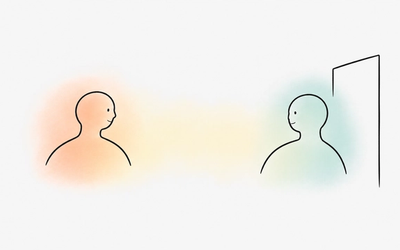
Security may be harder to read than intensity
This is one of the more useful findings.
People with lower self-esteem can underestimate how much another person likes or accepts them, particularly when rejection feels possible.
Imagine someone who has learnt:
“People leave.”
They meet one person who is calm, consistent and interested. That person does not chase, flood them with reassurance or create emotional intensity.
The insecure person may read this as:
“They are probably not that interested.”
Then they meet someone else who is also frightened of rejection.
That person messages more, reassures more, pursues more strongly or becomes intensely close very quickly.
Those signals may be easier to recognise.
So the second relationship gains momentum.
This may be one reason people sometimes describe security as “boring”.
The problem may not be boredom.
The secure person's interest may simply be quieter and therefore less legible.
We trust what fits our existing model
Another useful idea comes from self-verification research.
People do not only want to be seen positively. They also want to be seen in ways that fit their existing sense of themselves.
If someone carries a deeply established belief such as:
“I am difficult to love,”
being treated as straightforwardly lovable can feel unexpectedly uncomfortable.
They may think:
“You do not really know me yet.”
A partner whose behaviour fits the existing self-model may feel more believable.
This is not the same as wanting mistreatment.
It is closer to this:
the brain trusts familiar information more easily than contradictory information.
Coherence can feel safer than surprise.
The past can shape perception without conscious choice
There is experimental evidence that representations of important people from our past can become activated when we meet someone new who resembles them in some way.
Once activated, those old relational templates can influence what we notice, expect and infer.
Psychology calls this transference.
Some of this can happen outside conscious awareness.
That does not prove the more dramatic idea that people repeatedly recreate childhood relationships in order to heal them.
The evidence supports something simpler:
past relationships influence how present relationships are interpreted.
Can an insecure person still form a secure relationship?
Yes.
Attachment has some stability, but it is not fixed.
A person can be generally insecure and still develop a secure relationship with one particular partner.
Repeated experiences of responsiveness, consistency and acceptance can gradually alter expectations.
For example:
“When I need someone, they disappear”
can become:
“Sometimes I can need someone and they stay.”
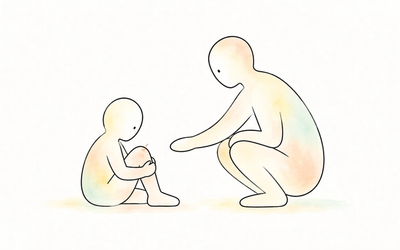
A secure partner can help create those experiences.
But a secure partner does not automatically transform the other person.
Reliability can reduce fear without necessarily producing greater autonomy, reciprocity or responsibility.
That distinction matters.
A person may become very secure in knowing:
“You will stay.”
without becoming more secure in:
“I can carry my share.”
Security of attachment and capacity for adult reciprocity are related, but they are not the same thing.
Must someone become secure before entering a relationship?
No.
The research does not support a rule that people must “heal first”.
There are several possible routes.
Someone can become more secure within a reliable relationship.
Someone can develop greater security through therapy, friendship, family relationships, reflection or other life experiences before meeting a partner.
Or two insecure people can gradually create a more secure relationship together.
What matters is not arriving perfectly secure.
It is whether the relationship increasingly develops:
predictability, responsiveness, repair, respect for autonomy, reciprocity and enough safety to remain in contact when either person's alarm system activates.
Security is something we bring and something we build
These processes can reinforce each other.
Greater internal security can make it easier to recognise quiet interest, tolerate uncertainty and leave relationships that remain chronically unsafe.
A secure relationship can then provide new experiences that challenge older expectations.
So development may look less like:
“Find a secure person and they will heal you.”
and more like:
some internal security → greater ability to recognise and use secure behaviour → safer relational experiences → greater security → greater capacity for reciprocity and repair
The useful question may therefore not be:
“Am I secure yet?”
It may be:
“Do I have enough security to recognise security when it appears, and enough capacity to let present evidence matter more than old predictions?”
Secure attachment does not mean never feeling frightened, uncertain or dependent.
It means becoming increasingly able to tell the difference between what the past taught you to expect and what this relationship is actually showing you now.