
When your own account stops counting

By Olena Baeva
Published 16 November 2026
Alex is in the back of the car on a family trip. Everyone else is enjoying the music. Alex has put headphones on, but can still feel the bass through the seat.
“Could we turn it down a bit?” Alex asks.
No one does. By the time Alex starts crying, someone says they’re spoiling the trip for everyone.
Later, the question Alex keeps coming back to is “Was I selfish to ask?”
I keep thinking about that shift. At the start, there was a volume setting someone could have changed. By the end, Alex was wondering whether they had any right to speak up.
How an impression becomes a verdict
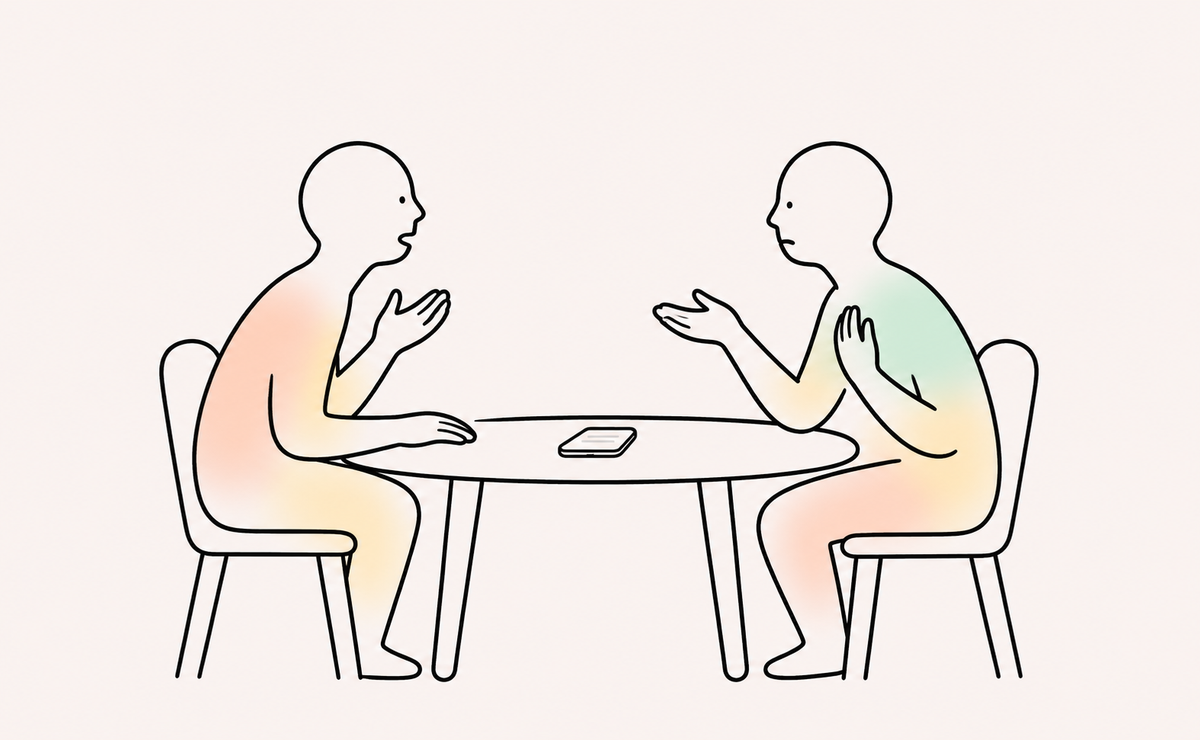
I think of invalidation as a shift in whose account gets to count. You tell me what you feel, what you can do, or what you think happened. I notice something that seems at odds with what you’ve said. Perhaps everyone else is enjoying the music. If I treat that as enough to decide how the music feels for you, you now have to persuade me that your discomfort is real before we even talk about turning it down.
It can start with something as small as a question. Sam asks Robin, “Did you use my hairbrush?” Robin says, “That’s your OCD.” Robin might remember other times when Sam got caught in a loop of checking and genuinely want to help. Sam’s question still has an answer. Did Robin use the brush?
Morgan notices that friends have started acting differently around them. Morgan knows how quickly the possibility of rejection can register as danger and wonders if they’re reading too much into it. Then a friend mentions something that’s been said about Morgan in their absence. Now there’s something specific to ask about. If I’d told Morgan, “That’s just your rejection sensitivity,” I might have made it harder for them to find out what was happening.
“See? You are angry”
Riley and Jordan have been talking for a few minutes about when to leave on Saturday. Jordan is working backwards from the train time.
“Why are you so angry?” Riley asks.
Jordan looks up. “I’m not angry. You’re imagining it.”
“I’m not imagining it. You’ve barely looked at me, and you sound really sharp.”
“I’m looking at the timetable. I’m trying to work out which bus gets us there in time.”
“You could just tell me if you’re annoyed with me.”
“I just told you I wasn’t.”
“Then why are you talking to me like that?”
Jordan puts the phone down. “Because you keep asking me to explain why I’m angry and you won’t believe me when I tell you I wasn’t. Yes, I’m angry now.”
“See?” Riley says. “You are angry.”
They started out working out which bus to take. By the end, the timetable is still open on Jordan’s phone and neither of them is looking at it.
When Jordan says, “You’re imagining it,” Riley is left defending what they heard. There’s something Riley wants Jordan to understand. “Your voice sounded sharp to me, and it bothered me.” That could be heard and taken seriously even if Jordan was simply concentrating.
Then Riley says, “You could just tell me.” Now Jordan has more to defend than their account of how they felt. Riley’s words imply that Jordan knows perfectly well they’re angry and is choosing to deny it. Jordan wants Riley to believe that they’ve been answering honestly.
Both want some compassion for what is happening to them. Riley wants Jordan to recognise the hurt of hearing that sharpness and then being told it was imagined. Jordan wants Riley to recognise the strain of answering honestly and being treated as though they’re hiding something. Each is asking for the very thing the other is struggling to give while defending their own account.
By the time Riley says, “See?”, Jordan is angry. The word now matters. Jordan is angry about what has happened in the last few minutes. Riley hears that anger as proof of what they thought at the start, and the hurt that brought it about goes unheard again.
The conversation split three ways:
- The shared task — “Which bus should we take?”
- Jordan’s honesty — “Will you believe me when I tell you what I was feeling?”
- Riley’s experience — “Will you take seriously how your voice landed with me?”
“You could just tell me” is Riley’s line, but it’s what puts Jordan’s honesty in question. “You’re imagining it” is Jordan’s line, but it’s what dismisses Riley’s perception and leaves Riley wanting the hurt acknowledged.
When explaining yourself counts against you
The same pattern can develop even when someone is trying to take responsibility. Imagine Casey notices that something they said has upset Taylor.
“I think I may have crossed a boundary,” Casey says. “I take that seriously. Can you tell me where I crossed it?”
“You’re being defensive,” Taylor replies. “I’ve tried really hard to say this clearly and gently. It feels like you’re disregarding that.”
Casey tries to explain that they wanted to understand where they’d gone wrong. Taylor hears the explanation as more defensiveness. Casey is now trying to account for the way they asked and still has no idea where the boundary was.
Casey may well have felt defensive. It can be unsettling to realise you’ve hurt someone and have no idea how. Taylor may also have put a great deal of care into raising something difficult. There’s room to ask where the boundary was crossed, what Casey heard when Taylor raised it, and what happened when Casey tried to explain. If every answer is heard as further evidence of defensiveness, what could Casey say that would help Taylor understand their response?
When what we see hides what it took
Jules is deaf and has been lip-reading throughout a conversation. “You’re so good at it,” a friend says. “I don’t need to learn to sign.” The friend has noticed something real. Jules has managed to follow much of the conversation. The work Jules did to make that possible is precisely what made the need for support harder to see.
I can hear how easily I might do something similar while trying to encourage someone. “You did it yesterday. I know you can do it today.” Perhaps yesterday they had more time, the room was quieter, or someone helped them get started. If I assume the task is equally accessible today, I may read their difficulty as reluctance. I can make the opposite mistake, too. If someone goes quiet when questions come thick and fast in a meeting, I may underestimate how well they understand the work. I might learn something different if they had time to reply in writing.
Sometimes it’s a person’s identity that gets treated as open to correction. When Ellis starts dating a woman, friends begin calling Ellis a lesbian, even though Ellis has told them they’re bisexual. At a reception, Avery says they’re British and were born here. The person they’re speaking to keeps asking where they’re “really” from. In both cases, the listener already has an answer in mind. The person being asked has already answered.
How we do it while trying to help
We may be trying to reassure someone when we say, “You don’t seem autistic to me.” We may want to help them interrupt a familiar cycle of doubt when we say, “That sounds like your OCD.” We may want to protect a boundary. The question I’d ask myself is whether the other person can still tell me something that would change my mind.
I find that harder when I’ve chosen my words carefully. If someone tells me they felt cornered, I know how much thought I gave to being clear without being harsh. I can feel the urge to explain what I meant before I’ve heard what they’re trying to say. Then we’re both explaining ourselves, each waiting for the other to take in something that matters to us.
In couples work, I’d want to slow down the moment Riley first heard sharpness. Riley might say, “Your answers sounded sharp to me. Is something going on?” Jordan might say, “I was trying to work out the buses. I can see how I might have sounded short.” If they’re already further into the argument, there’s another question available. “When did you start feeling angry?” Jordan’s answer could help both of them see what changed while they were talking.
Repeatedly having to defend your ability to know what you felt, saw or meant can wear away trust in your own judgement. That erosion can be part of gaslighting when someone uses their position to make you defer to their version of reality. In an ordinary conversation, I’d start with a question about my own part in it. What was this person trying to tell me before they had to start explaining themselves?
This piece was inspired by public accounts. Names, dialogue and some details have been adapted.
Further reading
- Zielinski and Veilleux on emotional invalidation
- Fricker on epistemic injustice
- Cheryan and Monin on identity denial
- Sweet on gaslighting and relational power