
When yes is hard to trust

By Olena Baeva
Published 17 October 2026
An illustrative composite case study about agreement, emotional responsibility and having room to remain yourself. Names, circumstances and dialogue are fictionalised; the explanations offered are possibilities to explore.
Morgan wants to enjoy an evening with friends. Casey has agreed to come.
Before they leave, Morgan is already watching: Is Casey unusually quiet? Getting ready reluctantly? Looking tired? Morgan wants to feel excited, but attention keeps returning to whether Casey will be all right.
At first, the evening goes well. Then Casey becomes uncomfortable and wants to leave.
Morgan feels disappointment, irritation and a familiar sinking sensation. Even after Casey goes home, Morgan cannot settle back into enjoying the evening. Having fun now almost feels disloyal.
The following morning, Casey apologises. Morgan does not particularly want an apology. They wanted to share something enjoyable, or to know earlier that separate plans would work better.
Casey may have wanted that too.
How can two people care about each other and still find themselves feeling trapped, responsible and alone?
When agreement carries too much
A yes can mean “I want to”. It can also mean “I hope I can”, “I ought to”, or “I cannot bear to disappoint you”.
For someone in Casey’s position, being asked about an outing might bring several feelings at once: affection, hope, uncertainty, guilt about previous cancellations, or fear of being a disappointing partner.
Agreeing may briefly ease that discomfort before they have worked out what they want or can manage.
Research into false confessions illustrates an extreme version of agreement used to escape immediate pressure. Some people endorse an account they do not believe because ending the interaction takes priority. This does not equate a relationship conversation with an interrogation. It invites us to ask what an answer is doing: expressing a position, seeking reassurance, or ending discomfort. saulkassin.org
Casey may instead be answering sincerely and discovering their limits later. We cannot know their experience from Morgan’s account alone.
When you say yes, what do you feel afterwards: interest, warmth, uncertainty, relief that the question has gone away, or several of these?
When care becomes watching
Morgan’s attention is increasingly organised around the possibility of Casey becoming unhappy.
Their internal questions multiply. Is the venue wrong? Have they stayed too long? Should Morgan suggest leaving before Casey asks? Could they have prevented this?
There is affection here, but also frustration. Morgan wants to be present with friends and with their own enjoyment. Instead, they are monitoring an evening they cannot fully control.
One possible cycle emerges: Casey’s discomfort prompts Morgan’s vigilance; Morgan’s vigilance makes the outing feel more consequential; both have less room to discover what they actually need.
That cycle is a hypothesis, not proof that either person caused the other’s feelings.
When your partner’s mood changes, do you experience it as information about them, a verdict on the occasion, or evidence that you have done something wrong?
Different experiences can both be real
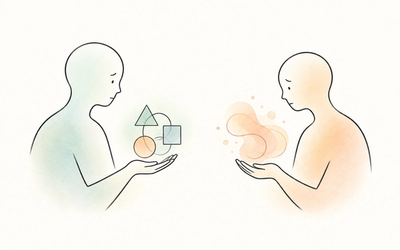
Morgan is enjoying the conversation. Casey may be reaching a limit with noise, social effort or tiredness.
From Morgan’s position, leaving can feel abrupt and hard to understand. From Casey’s possible position, continuing may have become much harder than it was twenty minutes earlier.
One person’s enjoyable environment can be another person’s costly one. Equally, Morgan’s disappointment deserves acknowledgement even if nobody could have predicted the change.
It may help to replace “That reaction is unreasonable” with “That experience is difficult for me to relate to”. This leaves room for curiosity without requiring either person to pretend they feel the same.
Can your partner be having a difficult experience while you are having a good one? What meaning do you attach to that difference?
A good day does not cancel the difficult days
Sometimes Casey is fully present, relaxed and enthusiastic. Morgan feels close to them again.
Yet relief may arrive alongside sadness. This is the companionship Morgan has missed. Why is it so difficult to explain the loneliness now that the connection is here?
Casey may feel hopeful too, perhaps assuming that today’s energy will remain available.
Both can acknowledge the good day without turning it into evidence that the difficulties were imaginary. Today’s connection matters. So does the accumulated effort of adapting around uncertainty.
Can you enjoy what is available today without using it to dismiss yesterday or promise tomorrow?
Chosen care needs room for limits
Agency includes choosing something because it matters to your partner. Casey does not have to love every gathering to choose to attend one.
Research on sacrifice in couples distinguishes moving towards valued experiences, such as closeness, from trying to prevent guilt, conflict or disapproval. These motives have different associations with wellbeing and relationship quality. Feeling that a contribution is authentically one’s own appears to matter. pubmed.ncbi.nlm.nih.gov
A willing contribution might be: “I’d like to come for the first hour, then travel home separately.”
Leaving while some energy remains could protect the experience. It need not mean wasting every remaining moment of enjoyment.
What could you offer willingly if you did not have to promise the whole evening? What would help you notice and communicate a limit before reaching it?
Permission needs to work in practice
Morgan may sincerely say, “You don’t have to come.” Casey may still anticipate guilt or disappointment. That expectation could reflect past experience, present interactions or their own standards for being a good partner.
Research on compliance in autistic adults is mixed. One small study found greater compliance, but questionnaire scores did not predict behaviour in the experimental task. It would be too simple to make this an autistic trait or assume the same mechanism in every relationship. purehost.bath.ac.uk
A practical starting point is to separate desire, capacity and commitment. Someone can want to attend, be uncertain about their energy, and commit only to a limited version.
There also needs to be a way to pause a decision without agreeing first, followed by a manageable return to it. Otherwise, the other partner remains responsible for chasing an answer.
What happens when you say “not this time”, “I don’t know yet”, or “I need to revise my answer”? Is there room for those answers without punishment or repeated persuasion?
Both people get to have feelings
Morgan can feel disappointed without Casey having to reverse a limit. Casey can feel overwhelmed without Morgan having to abandon their own enjoyment.
Where there are shared responsibilities, both still need to negotiate practical arrangements. Emotional freedom does not remove those responsibilities.
Research on autonomy in couples links personally endorsed relationship motivation with less defensive responses to conflict. The practical aim is to make both people’s positions available for negotiation, while recognising that these suggestions are not a tested protocol for this particular pattern. pubmed.ncbi.nlm.nih.gov
Perhaps Morgan needs to hear that Casey’s departure is about capacity, rather than rejection. Perhaps Casey needs to discover that Morgan can feel disappointed and still respect their decision. Neither should have to manufacture cheerfulness to make the other’s choice permissible.
Can you care about your partner’s feelings without making yourself responsible for removing every uncomfortable one?
A more trustworthy agreement might be smaller, more specific and easier to revise. It might also leave Morgan free to enjoy the evening and Casey free to leave before enjoyment becomes endurance.
A trustworthy yes needs room for an honest no, an unfinished answer and a freely chosen contribution.