
Aunxiety: when ‘anxiety' isn't the right word

By Olena Baeva
Published 26 February 2026
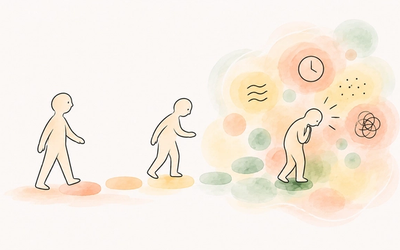
You want to go. You like the people. You expect nothing terrible to happen. Yet, as the time approaches, your chest tightens and everything in you wants to cancel.
“What are you worried about?” is difficult to answer. You may not be predicting embarrassment, rejection or disaster. You may be anticipating what participating will do to you: the effort of staying present, the point at which speech becomes difficult, the exhaustion afterwards.
The event may be welcome. Its cost may feel unaffordable.
This is the experience I want to make more intelligible through aunxiety: a working term for autistic anxiety-like distress, understood here through a cost-forecast formulation. It is a way of exploring experience, rather than an established diagnosis or a proven account of a single biological mechanism.
What will this require of me?
An invitation describes an activity. Your experience supplies the rest.
“Dinner with friends” might mean following several conversations through background noise, managing unfamiliar food, finding the right moment to speak and negotiating when to leave. Tomorrow may involve working while still recovering.
The forecast therefore concerns more than whether dinner will be enjoyable. It concerns whether you have enough capacity for the whole experience.
A useful question is:
“What do I expect this to cost, and what do I have available to meet that cost?”
This need not happen as a conscious calculation. You may notice dread before you can explain it. The formulation gives us something to investigate when the body’s response arrives without a clear worry story.
It also makes room for an apparent contradiction: wanting an experience while feeling unable to afford it.
Dread can contain knowledge
There is a difference between “Something awful might happen” and “I recognise what happens to me in these conditions”.
Someone who repeatedly loses access to speech in crowded settings may anticipate being unable to ask for help. Someone who needs two days to recover from a social evening may dread losing their weekend. The feared consequence can be the loss of capacity itself.
Reassurance that “Everyone there likes you” addresses rejection. It leaves the expected exhaustion untouched.
That does not make every forecast accurate. Earlier experiences can shape expectations even after circumstances improve. Anxiety can also magnify expected costs. But we cannot establish that a forecast is exaggerated without first understanding what it predicts.
The useful distinction is between the cost supported by experience, the uncertainty surrounding that cost and any additional fear that has gathered around it.
Uncertainty makes the cost difficult to contain
“Let’s see how the evening goes” can sound relaxed. It can also mean there is no reliable endpoint.
Without knowing the duration, expectations or options for leaving, you cannot tell what you are agreeing to spend. A short visit might expand into dinner. Dinner might become pressure to stay longer. Leaving might require an explanation when explaining is already difficult.
In this formulation, uncertainty matters partly because it prevents you from putting a boundary around the expected demand.
That suggests a different use for predictability. An agreed finishing time, clear expectations or independent transport can make participation feel more possible because the commitment now has edges.
Sometimes knowing that you can leave is what allows you to arrive.
Capacity changes the meaning of the same event
The same invitation can feel manageable one week and impossible the next.
This can look inconsistent if we examine only the invitation. It becomes more intelligible when we include what is already being carried and what recovery is available afterwards.
A quiet evening ahead may make a demanding appointment affordable. Another obligation immediately afterwards may change the forecast completely.
Being told “You managed it last time” can miss this distinction. Last time may have required every available resource. It may also have carried an invisible cost.
Attendance tells us that someone got through an event. It does not tell us whether the experience was sustainable.
Recovery belongs inside the forecast
The cost of an event does not necessarily end when the event finishes.
There may be a period of reduced speech, decision-making or tolerance for further input. Ordinary tasks may become harder. Something enjoyable can still use capacity needed elsewhere.
If recovery repeatedly gets interrupted, the next demand arrives before the previous one has been absorbed. In the cost-forecast formulation, increasing dread may reflect that accumulating shortfall.
This changes how we understand cancellation. It may protect the capacity needed to work, eat, maintain a home or remain available to someone important.
It also changes what counts as progress. Doing more is only one possibility. Participating with a smaller recovery cost can be a substantial improvement, even when nobody else notices.
What would make the forecast different?
If we work with this formulation, support needs to address the specific cost being anticipated.
We might ask:
- What is the expensive part? Following conversation, switching tasks, suppressing discomfort, travelling or explaining your needs?
- Where does choice disappear? Can you pause, change your mind or leave without having to defend the decision?
- What happens afterwards? Is recovery possible, or will you immediately owe more effort?
- What has changed since the experiences informing this forecast? Are the conditions more manageable now, and is that change dependable?
These questions help distinguish a prediction that needs updating from a situation that still needs changing.
A shorter visit with a trusted person and an agreed departure time can provide useful new information. Repeating an overwhelming experience under the same conditions may simply confirm the original forecast.
The aim is to build evidence that participation can be manageable, with the person retaining authorship over how it happens.
A more useful conversation
Aunxiety does not explain every anxious experience an autistic person has. Body-first distress also occurs outside autism. Its value here is the question it opens.
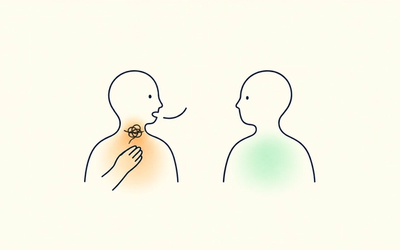
When someone says, “I know nothing bad is going to happen, but I still cannot do it,” we can explore what “bad” has left out.
Perhaps they expect to enjoy themselves and then lose the following day. Perhaps they trust the people but cannot trust that their need to stop will be respected.
“What would make this affordable for you?” may reach something that “What are you afraid of?” has missed.
The answer can help someone remain involved in life with enough capacity left to inhabit it.