Why neurotypical people misjudge autistic people fast: neurotransception theory

By Raymi Doyle (conceptual framework) – adapted summary
Published 3 January 2026
Ten seconds can be enough for someone to form an impression of you. It is not enough for them to know you.
In experimental studies using brief audio and visual samples, non-autistic observers have tended to rate autistic people less favourably and report less willingness to interact with them. When observers receive only a written transcript, the difference often reduces or disappears. The original thin-slice study by Sasson and colleagues found this pattern, and a 2025 meta-analysis of 21 articles and 221 effects found broadly similar results: less favourable first impressions across presentation formats other than speech transcripts, with moderate-to-large effects overall.
These findings matter, but they need careful wording. The studies measured ratings and reported intentions, not a complete account of how someone would behave in a real relationship. They show a reliable social bias; they do not establish that autistic people communicate badly, nor do they prove a particular nervous-system mechanism.
What they do show is that people respond not only to what is said, but also to how bodies, voices, faces, timing and movement are interpreted. Those interpretations are shaped by familiarity, expectation, context, stigma and power.
The emerging concept of neurotransception offers one way to think about this between-person process.
What neurotransception is trying to name
Neurotransception was developed by psychotherapist and researcher Raymi Doyle through qualitative doctoral research and clinical work. Doyle uses the term to describe the relational transmission and reception of embodied cues: the ways people may register one another's voice, posture, facial movement, pace, proximity and other signals, often before either person has consciously decided what those signals mean.
This can help us ask a more useful question than “Which person is communicating incorrectly?”
We can ask:
- What is happening between these two nervous systems, in this context, under these conditions of power?
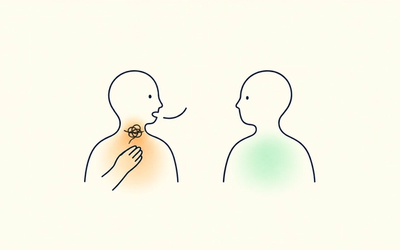
Neurotransception is best treated as a working relational framework, not an established biological theory or a validated clinical method. It gives language to a recognisable experience: one person's signals can alter another person's felt sense of ease, uncertainty or threat, and that altered state can then change the signals sent back.
A simple relational loop
The process is often described as a loop:
Cues ↔ predictions ↔ bodily state ↔ meaning ↔ behaviour ↔ new cues
The arrows run both ways. Cues, expectations, bodily state and meaning continuously update one another. Much of this may occur outside conscious awareness, but there is no reliable single sequence in which the body always reacts first and thought merely follows.
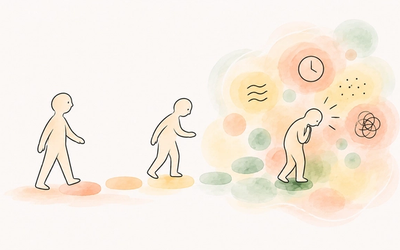
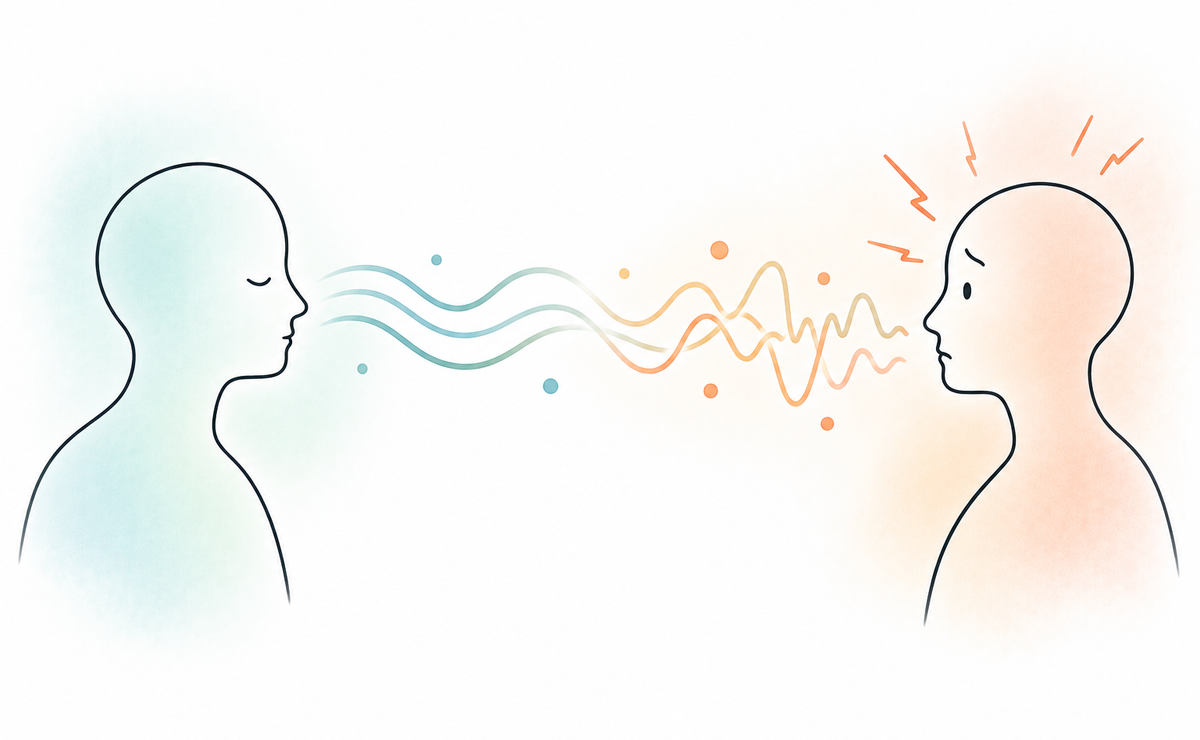
Imagine that someone speaks with little visible facial animation. Another person predicts disapproval and becomes tense. Their voice sharpens; they ask more questions; they move closer or become overly reassuring. The first person experiences this as pressure and becomes quieter. Their quietness is then read as further evidence of disapproval.
Neither person has to intend the escalation. Each is responding to the other, while also responding to memory, context, sensory load and learned expectations.
This is one reason social difficulty cannot be located inside one person alone. It is produced within an interaction.
Behavioural or physiological synchrony is sometimes discussed in research on social interaction. Synchrony can be interesting, but it is not proof of safety, agreement or accurate understanding. Similar bodily patterns can accompany very different experiences, and apparently smooth coordination can coexist with masking, compliance or fear.
Fast bodily signals are data, not verdicts
Many people recognise the experience of “something feels off”. Sometimes that signal helps us notice risk before we can explain it. Sometimes it reflects unfamiliarity, previous harm, stigma, sensory overload or a prediction that has not yet been tested.
A fast bodily signal is data, not a verdict.
Feeling safe does not prove that a person or situation is safe. Activation does not prove danger. Familiarity can feel safe even when a pattern is harmful; difference can feel threatening even when no harm is present.
The task is neither to obey the body unquestioningly nor to overrule it. It is to become curious about what the signal may have detected, distinguish observation from interpretation, and test the meaning where possible.
That distinction is particularly important in cross-neurotype encounters. Limited eye contact may mean concentration, sensory regulation, cultural difference, anxiety, pain, dissociation, lack of interest, or something else entirely. A flat or highly animated voice can be interpreted in several ways. A pause may indicate uncertainty, processing time, disagreement, overwhelm or care with language.
One cue rarely tells the whole story.
What the first-impression research shows and what it does not
The thin-slice findings are consistent with a cue-mismatch account, but they do not test neurotransception directly or establish its proposed physiological mechanisms.
The evidence does tell us several useful things.
First, observer characteristics matter. In a study involving 20 autistic people and 505 non-autistic raters, Morrison and colleagues found that variation in impressions was driven substantially by the raters, especially when they judged whether they wanted to interact. Knowledge about autism, prior contact and stigma affected the ratings. Diagnostic disclosure often improved impressions, but for raters with higher stigma it could make some judgements worse.
Second, format and context matter. A 2023 study of autistic and non-autistic children found particularly strong negative impressions in audio conditions, while some differences remained even when raters saw transcripts. A 2025 study also found that the context in which someone was presented, such as a job interview or a discussion of a personal interest, and whether autism was disclosed influenced first impressions.
Third, interaction is not the same as distant observation. Research on autistic, non-autistic and mixed-neurotype conversations found that outside observers rated mixed-neurotype interactions as the least successful. Yet the people who actually took part in the conversations evaluated autistic participants more favourably than observers did. A person watching a brief extract may therefore reach a different conclusion from someone who has shared the interaction.
The careful conclusion is not “style matters and content does not”. Presentation cues often contribute substantially to first impressions, while content, context, observer characteristics and the relationship itself also matter.
Prediction gaps without mystifying them
One way to understand rapid social interpretation comes from predictive-processing approaches. The brain does not passively wait for complete information. It uses previous experience to anticipate what incoming signals are likely to mean, then updates those expectations when something does not fit.
In social situations, this can happen quickly. If a person's timing, expression or tone falls outside another person's expected pattern, the mismatch may create uncertainty. The mind often resolves uncertainty by producing a story: bored, rude, angry, untrustworthy, too intense, not interested.
But a confident story is not the same as accurate knowledge.
The useful intervention is not to eliminate prediction. Human perception cannot operate without it. It is to notice when a prediction has been mistaken for a fact and to create enough capacity for checking:
- “I noticed you went quiet. I am not sure what that means for you.”
- “I may be reading your expression as frustration. Is that accurate?”
- “Would more processing time help, or would you prefer to stop?”
These questions reduce guesswork without demanding that either person perform a more socially familiar version of themselves.
Double empathy: mutual does not mean equal
The double empathy problem proposes that misunderstanding between autistic and non-autistic people can be mutual rather than evidence of a one-sided autistic deficit. Recent scholarship argues that it is best understood as a relational and sociological account shaped by context, familiarity and power, not as a simple biological mechanism or a claim that every misunderstanding is perfectly symmetrical. A 2026 critical review describes double empathy as probabilistic: it identifies conditions under which understanding may become harder, not a rule that predicts every encounter.
Mutuality does not mean equal power, equal consequences or equal responsibility.
Both people may contribute signals and interpretations, while only one may have the authority to diagnose, exclude, employ, punish, restrain or define what happened. The person with more institutional power may have their interpretation recorded as fact. The other person's regulation may be documented as resistance, their directness as aggression, or their need to leave as non-compliance.
Any relational account that ignores this asymmetry risks turning “both sides” into a way of avoiding responsibility.
In the therapy room
Therapy is not outside this process. Therapist and client continually affect one another, and the therapist holds role-based power even in a warm, collaborative relationship.
An autistic client may speak precisely, correct an inaccurate summary, give little visible reassurance or need time before answering. A therapist who expects familiar signals of rapport may feel ineffective or rejected. If the therapist treats that feeling as evidence about the client, they may explain more, push for emotional disclosure, soften language the client wanted kept precise, or try to “repair” a rupture that the client did not experience.
The client then feels pressured, misread or managed. They may freeze, appease, become more literal, leave the session or stop returning. Those responses can then be used to confirm the therapist's original formulation.
The clinician's discomfort is not meaningless, but it is not a diagnosis. It is information to take to reflection and supervision.
Useful questions include:
- What did I directly observe, and what did I infer?
- Which signals of safety or engagement was I expecting?
- Am I interpreting difference as resistance, avoidance or lack of insight?
- What sensory, cognitive, emotional or communication demands are present?
- Have I checked my reading in language the client can answer?
- Does the client have a genuine way to disagree, pause, leave or return?
- What power do I hold, and how might it shape the client's capacity to correct me?
The aim is not to make structural power disappear; it cannot. The aim is to name it, reduce unnecessary coercion, create genuine opt-outs and make correction safer.
Mechanism does not cancel responsibility
A nervous-system or predictive account can explain how a harmful interaction developed. It does not erase the impact or remove responsibility.
It helps to separate five things:
- Observable behaviour: what was said or done.
- Inferred motive: the story told about why it happened.
- Impact: what happened to the other person.
- Available capacity: what each person could realistically notice or change in that moment.
- Afteraction: what a person does once the impact is made known.
Someone can cause harm without intending it. Someone can also invoke difference, trauma or dysregulation to avoid engaging with harm. The important evidence comes next: do they become curious, adapt and attempt repair, or continue defending the interpretation and behaviour that caused the problem?
Mechanism before morality does not mean morality never matters. It means we understand the process before assigning character. Capacity before expectation does not mean there are no expectations. It means expectations must be possible, explicit and proportionate. Explanation can support accountability because it shows where a different action may become available.
What remains uncertain
Neurotransception draws some of its language from neuroception, a concept originating within Stephen Porges's polyvagal theory. Polyvagal theory remains clinically influential, but its evolutionary, anatomical and physiological claims are actively and substantially disputed. In February 2026, an international expert evaluation argued that several central claims were untenable; Porges published a response disputing the critique's interpretation of the theory and evidence.
Here, neuroception is therefore used as a clinical metaphor for rapid, often non-conscious appraisal, not as a proven neural safety detector or unquestionable biology.
More broadly, researchers are increasingly studying social interaction as coordination between embodied people rather than as isolated cognition. A 2026 perspective on interpersonal synchrony is compatible with this relational direction, but it is a perspective, not empirical validation of neurotransception. Findings on synchrony remain heterogeneous, and bodily measures do not map neatly onto one emotion or meaning.
The responsible position is to keep the useful clinical questions while remaining honest about the evidence:
- Autistic people are often judged less favourably from brief social samples.
- The observer's expectations, stigma and familiarity help shape that judgement.
- Cross-neurotype interaction can create reciprocal mismatch.
- Context and power influence whose interpretation is treated as authoritative.
- Neurotransception is an emerging conceptual lens, not a standardised or validated treatment model.
- Thin-slice research does not prove a specific autonomic mechanism.
Three changes that help in practice
1. Do not mistake mismatch for misconduct without enquiry
Separate observable behaviour, inferred motive, actual impact, available capacity and afteraction. Difference is not misconduct by default; understanding difference does not excuse repeated harm.
Instead of “They were dismissive”, try: “They looked away and did not respond for about twenty seconds. I interpreted that as dismissal. I need to check what was happening and describe the impact.”
2. Make implicit cues explicit
Do not require people to infer the purpose of a question, the state of the relationship or the meaning of your face and tone.
Try:
“I am pausing because I am thinking, not because you have said something wrong.”
“This question is optional. I am asking because it may help us understand the pattern.”
“I am not expecting eye contact. Please position yourself in the way that helps you process.”
“We can stop, change topic, write instead, or return to this next time.
Explicitness is not a remedial concession. It reduces the amount of unspoken social prediction required from everyone.
3. Treat power and capacity as part of the interaction
Ask who can safely say no, whose account will be believed, and what consequences follow from misunderstanding. Make choices real rather than decorative. Adapt pace, sensory conditions, communication mode and expectations before concluding that someone is unwilling.
Pausing, leaving or reducing speech may be protective regulation rather than deterioration. Repair may require space first, followed by a clear route back.
A final thought
When uncertainty is made more explicit, people may have more room to check meaning rather than rushing to judgement. That does not guarantee kindness or accuracy, but it creates better conditions for both.
Neurotransception is a working relational lens for how cues, predictions, bodily states, context and power may shape felt safety and meaning between people.
Its value is not that it gives us a new way to declare what another person's nervous system is doing. Its value is that it reminds us to slow down our certainty, make the implicit more explicit, and remain accountable for what happens next.